
Is Getting a Doctorate Economically Viable?
Chief Editor, Lemmy Brooks Journal
5/24/20263 min read
It’s the ultimate academic dilemma. You spend four to seven years of your life surviving on coffee, writing a dissertation that maybe five people will read, and earning a stipend that feels closer to an allowance.
People often pursue a PhD out of passion, curiosity, or a love for research. But if we strip away the intellectual romance and look strictly at the dollars and cents, is a PhD actually a financially advantageous investment?
The short answer: It depends entirely on your field and your post-grad goals. Let’s break down the hidden costs, the lifetime earnings potential, and how the financial equation changes depending on your discipline.
The Hidden Math: Opportunity Cost
When calculating the economic viability of a degree, most people look at tuition versus starting salary. But with a PhD, the biggest financial hurdle isn't tuition (most reputable programs are fully funded)—it’s opportunity cost.
Imagine two peers graduating with a Bachelor’s degree at age 22:
Peer A (The Workforce): Enters the corporate world, starts earning $65,000, gets annual raises, and contributes to a 401(k) with a company match.
Peer B (The PhD Student): Spends the next 6 years earning a graduate stipend of $30,000 to $35,000, barely covering rent and groceries, with zero room for investments.
By age 28, Peer A has earned roughly $400,000 in cumulative salary and benefited from six years of compound interest. Peer B is starting from scratch with a net worth of near zero. For a PhD to be a lucrative endeavor, Peer B must earn enough of a premium over the rest of their career to close that massive head start.
The Economic Divide: STEM vs. Humanities
When it comes to return on investment (ROI), academia is deeply segregated.
1. STEM (Science, Technology, Engineering, Math)
If you are getting a PhD in Computer Science, Data Science, Chemical Engineering, or Pharmacology, the ROI can be incredibly high—provided you leave academia.
The Industry Premium: Tech giants, pharmaceutical companies, and quantitative hedge funds actively recruit PhDs. A Machine Learning PhD can easily command a starting salary deep into six figures, quickly erasing the opportunity cost of graduate school.
The Verdict: Highly Lucrative (if you go into the private sector).
2. Humanities and Social Sciences
For fields like History, English, Philosophy, or Anthropology, the financial math is brutal.
The Academic Trap: These fields rarely have highly compensated private-sector equivalents. The traditional path is a tenure-track professorship, but those jobs are vanishingly rare. Many PhDs end up as adjunct professors, earning modest wages with limited job security.
The Verdict: Financially Risky. Unless you pivot into corporate consulting, corporate communications, or government research, the lifetime earnings rarely make up for the lost years of income.
Lifetime Earnings: PhD vs. Master's vs. Bachelor's
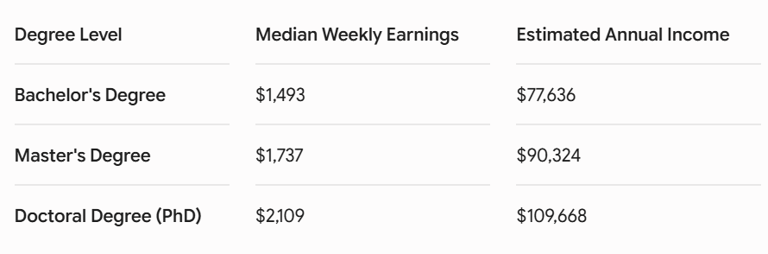
Data from the U.S. Bureau of Labor Statistics (BLS) consistently shows that higher degrees correlate with higher median earnings and lower unemployment rates.
On paper, a PhD earns about $32,000 more per year than a Bachelor's holder. Over a 30-year career, that’s an extra million dollars.
However, there is a catch: A large portion of that PhD premium is driven by high-earning STEM grads. Furthermore, in many fields, a Master’s degree gives you 80% of the salary bump of a PhD but takes only 1 to 2 years to complete, making it a much more efficient financial vehicle.
The Non-Monetary Returns
While we are focusing on financial metrics, it’s worth noting that the returns aren't just about your bank account. A PhD grants you:
Credibility and authority in your field.
Access to high-level, intellectually stimulating research roles.
The freedom to steer your own intellectual projects.
If absolute autonomy and solving complex, novel problems give you deep satisfaction, that is a form of intrinsic value that a standard corporate job can’t buy.
The Bottom Line: Should You Do It?
If your primary goal in life is to maximize wealth, a PhD is rarely the optimal route. A Master's degree combined with early entry into the workforce is almost always the more financially advantageous path.
However, a PhD can be an economically sound decision under specific conditions:
You are in a high-demand STEM field.
Your program is fully funded (never pay out of pocket for a PhD).
You are willing to work in industry rather than holding out for a rare university professorship.
Go into a PhD program with your eyes wide open. Love the research, but respect the math.
In our next blog post, we will expose a critical reality of the academic job market: the adjunct hole. It’s the systemic trap of short-term, low-wage teaching contracts that graduate schools rarely discuss with prospective students. Stay tuned as we break down what it is and how to avoid it.


14173 Northwest Fwy
Unit #2016
Houston, TX 77040
Connect
Inspire
info@lemmybrooksjournal.com
+1-281 236 7392
© 2024. All rights reserved.
Address